One of the greatest challenges confronting organizations is how to select and develop leaders.
Many Leadership theories were written by scholars, some were very effective and other were criticized for impractical the main arguments were as culture and generation change the leadership style change along, lot of contemporary leadership theories are no longer applicable modern era (kevin 2004). But the trouble with leadership theories is they’re easy to hide behind often inaccurately. They become proxies for actual leadership when something important is on the line, people don’t follow Fayol’s segregation of activities or Mintzberg’s three categories of managerial roles they follow real people. Leadership has evolved to the extent that our human context has evolved On the other end of the spectrum is the Situational Theory of leadership, which presumes that great leaders are more the product of circumstantial factors than innate ability (USB university, 2017).
Issues of leadership in today’s world
Historically in an organization people more engaged in production where a particular leadership is applied, such as transaction leadership or autocratic style, where workers are motivated by rewards and managers lead by transaction with their followers in respond to the behavior of workers and to boost production, (Max Weber in 1947) only handful of people possess basic knowledge. These leadership styles were indeed effective in the last centuries and this led to substantial growth of economy They were more affective to undertake operations efficiently, manage large corporations, or lead international projects that require rules and regulations to complete objectives on time or move people and supplies in an organized way, (Mujkic, Alisa, 2014).
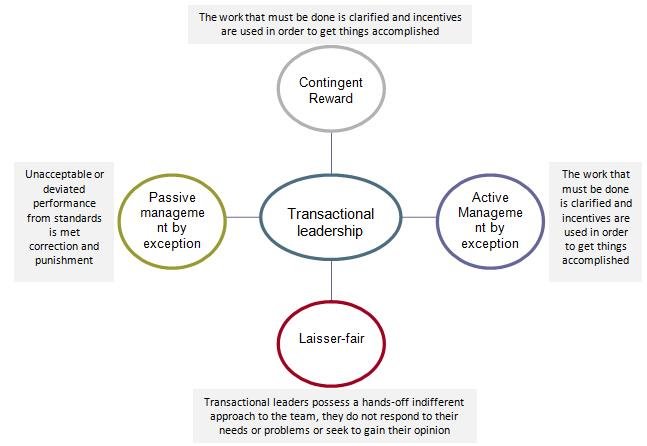
The challenges current leaders are experiencing in leading in a changing world
The biggest challenge current leaders facing is managing the different geographical diverse culture employee in respond to the globalization, more global mindset managers are needed for building & fostering value creation, also the global skill set which is far beyond just language but social etiquettes. The rapid changing environment, the different national culture and different team need are also of the challenge leader need to be dealt with which require huge amount of corporation between leader and the followers, (Kevin, 2004).
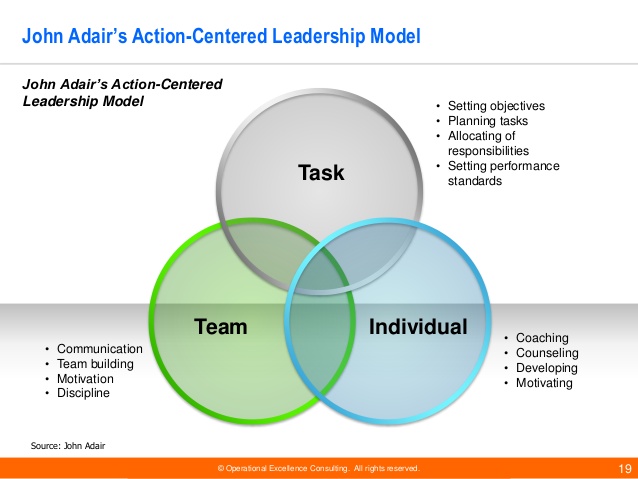
John Adair team theory
HP as an example
The transactional model is likely to succeed in a crisis or in projects that require linear and specific processes. Hewlett-Packard, a company known for its extensive use of management by exception it was very successful and inspiration to the employee in 1990s sales grew by 20% between 1992 & 1996 with an increasing dependency on the low margin PC & Printer business. By 1997, HP was among the top 3 manufacturers of PC. Due to the change in social and culture in the recent years (HP) board of directors have been in the limelight for wrong reasons. Four CEO’s were hired and replaced in the last decade and three CEO’s changes were within a span of 1.5 years. The board has not been able to find the right leader to fit into the HP’s Cultures of doing things. The uncertainties in leadership has led to a huge loss for HP in terms of decreased market value, dissatisfied shareholders and blurred strategic vision, (Kort, 2018).
Whereas in today era people engaged more in knowledge oriented job and production are mainly left to the machine, some of the traditional leadership are not a good fit for places where creativity and innovative ideas are valued. The other leadership style that frequently being used by some managers is the transformative leadership, (Burns, 1978). Burns, said that “transformational leadership occurs when one or more persons engage with others in such a way that leaders and followers raise one another to higher levels of morality” (1978). Mohandas Ghandi is frequently cited as a classic exemplar of transformational leadership (Northouse, 2007).
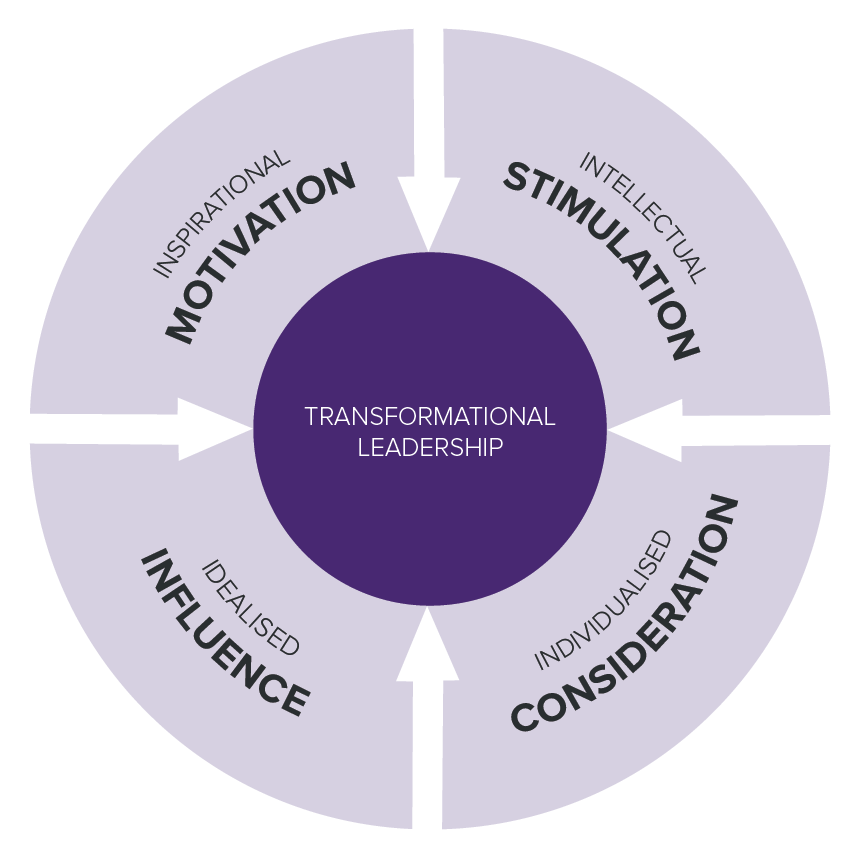
Transformational leaders tend to have dedicated and satisfied followers. Furthermore, they empower their employees, pay attention to their needs and development, helping them grow their own leadership potential (Bass, 2008).
How relevant are they in today’s changing world?
By definition they are still quit relevant, particularly the transformative leadership by reviewing it can be noted that transformational leaders tend to create a working environment with satisfied and motivated employees (Bass, Riggio, 2008), Bushra et al. (2011) argue in their research that transformational leadership has a significant positive effect on the level of employee job satisfaction in general. The same study supports the view that adopting the transformational style of leadership leads to raising employee engagement in the work by 42%, (Jams, 2009).
In the history of leadership models in the 20th century, there is no such thing as the perfect model of leadership. Of the leadership models theories written, it may seem that the more recent theories are more applicable to address contemporary leadership issues however each brings its own set of unique perspectives on situations, culture, structure, and process that need to be taken into account. In applying any leadership model to a given set of circumstances, it is important to understand the context, limitations, and biases introduced by each one so as to understand the limitations of the solutions they present as alternatives. It is also important to understand that measuring the effectiveness of each model may present unique challenges as new techniques for measuring the success are improved upon.
References
James O. McDowelle, 2009, Journal of Curriculum and Instruction, A Contemporary Consideration of Transformative Leadership, Volume 3, Number 2, (November 2009).
Burns, J. M. (1978). Leadership. New York: Harper and Row.
Lewin, K. (2019). Leadership StylesChoosing the Right Approach for the Situation. [online] Mindtools.com. Available at: https://www.mindtools.com/pages/article/newLDR_84.htm [Accessed 3 Apr. 2019].
Antoine, P. (2004) Fiedler’s Contingency Theory of Leadership [online] available from < http://www.stfrancis.edu/ba/ghkickul/stuwebs/btopics/works/fied.htm> (12 March 2019).
Kevin 2004, Knomaze Corporation, Leadership – Past to Present [online] available from < http://www.knomaze.com/leadership/leadership-past-to-present/ > ( 12 March 2019).
Mujkic, Alisa; Sehic, Dzevad; Rahimic, Zijada; Jusic, Jasmin.Ekonomski Vjesnik; Osijek Vol. 27, Iss. 2, (2014): 259-270.
Mujkic, Alisa, 2014 TRANSFORMATIONAL LEADERSHIP AND EMPLOYEE SATISFACTION, proquest [online] available from https://search.proquest.com/abicomplete/docview/1645743058/fulltextPDF/8374E40E55D04F19PQ/1?accountid=10286 > (12 March 2019).

 Adam abadjido
Great! This blog totally explains the specific part of leadership style. nowadays, many leaders have the biggest challenges within organizations. it can be useful for many leaders. Well Done Adam!
LikeLike
Dear Su
Thank you for your positive opinion, Although the contemporary leadership were successful for s long time of period, the great man and old leadership theories have contribute a lot in our today leadership .
thank you
LikeLike
Adapting to change and current situations going on around the organization most times determines the type of leadership styles to be adopted. good job Adam!
LikeLike
you are absolutely right Zee, that is why the situational leadership is more appreciated than the other leadership .
thank you for your opinion
LikeLike
Dear Adam
your transformational leadership style still effective in the modern world, but in some organization where workers are motivated by rewards and managers lead by transaction with their followers in respond to the behavior of workers and to boost production, in these situation transactional leadership is resulted more effective.
thank you well explained
LikeLike
Mr Saeed
Thank for your opinion
what i would suggest is to use both interchangeably, in respond to the situation and worker motivational method. but the transactional leadership style may not effective in time of economic downturn or company not profitable enough, as in this case organization will not have enough to reward its workers, whereas in the transformational leadership would succeed in both situation .
LikeLike
Interesting Blog and quite thoughful
Makes me think will it be so hard to be a leader in dis generations even if if we have the potential to be a leader as u have explained it well but still makes me think though🤔
LikeLike
My dear Sunny ‘
It is always hard to be leader, specially in this rapid changing world. As the contingency leadership theory mentioned, leader has to constantly learn and develop, not just claiming you are a born leader as this was the assumption of most failed leader.
the other way to deal with this is to get feedback about your leadership from your fellow to improve your shortcoming.
hope i have answered your question
thank you
LikeLike
Dear Adam
There were never a best leadership style, there was always an introduction of new leadership, this was not because the other leadership are not effective, but due to change in the environment and the people behavior new leadership style has to be implemented to cope with the particular timing or environment. I agree with your point of there are still some effective leadership theory in today’s world. but it is also recommended to introduce new leadership style to deal with the new generation. nice blog
LikeLike
Mr Abdallah
I acknowledge your opinion in term of leadership style has to be changed, but the previous great theorist have introduced enough leadership models, such as transformational leadership and Adair leadership need, all these leadership theory can serve us a lot even in our today’ world .
thank you for your opinion
LikeLike
Nowadays, people engaged more in knowledge oriented job and production how would you improve your employment if you are the leader of the manufactural industry? Would you consider using traditional leadership at all?
LikeLike
Dear Angela
this is very important question. As the manufactural industry are more Task culture leadership to increase productivity mainly using the traditional leadership, but this leadership were criticized for high employee turnover and training cost .
but applying the modern leadership will improve their employee turnover and less need to spend on training and education .
LikeLike